

PrEP is for Everyone: What We’ve Learned, So Far…
In January 2026, PlusInc announced the commencement of its “PrEP is for Everyone” campaign (Hopkins, 2026). This campaign, sponsored by Gilead Sciences—maker of Truvada, Descovy, and Yeztugo—was designed to increase awareness and eventually uptake of a PrEP regimen to prevent the acquisition of HIV.
In the months after our announcement, we hosted 3 community roundtables with community members and subject-matter experts representing our three primary demographic groups: Black and Hispanic/Latine Americans and Women, during which we conducted qualitative research to identify barriers and facilitators to knowledge and access about PrEP, as well as to identify community-driven recommendations and potential solutions to overcome those barriers. In addition to this qualitative research, we conducted a literature review for the first two demographic groups, with additional literature being gathered for the third in the coming months.
While the majority of our findings are being reserved for the final report, which will be issued in the 4th Quarter of 2026, we’re pleased to share what we’ve learned, thus far…and what we’ve learned has been startling:
Black Americans
Black Americans compose just 14.7% of the United States population (U.S. Census Bureau, n.d.), but account for nearly 38% of all new HIV diagnoses, with a diagnosis rate of 41.9 new diagnoses (per 100,000 Black Americans).
These data aren’t new: Black Americans have long had the highest rates of new HIV cases out of any racial demographic group. When broken down into new diagnoses by sex (as opposed to gender, due to the availability of official data), Black Males account for 28.4% of all new diagnoses, while Black Females account for 9.3% (Centers for Disease Control and Prevention, 2025).
Despite the availability of highly effective medication-based HIV prevention methods, Black Americans account for just 14.5% of all PrEP users, with a PrEP-to-Need ratio of 5.8, meaning that nearly 6 Black Americans are using PrEP for every 1 new HIV diagnosis. By comparison, White Americans account for 62.9% of all PrEP users, with a PrEP-to-Need ratio of 41.7, meaning that nearly 42 White Americans are using PrEP for every 1 new HIV diagnosis (AIDSVu, 2026).
In our qualitative interviews, participants across two separate roundtables indicated that the following issues served as primary barrier categories to knowledge about and access to PrEP and HIV care and prevention services:
Medical Mistrust Barriers
Structural and Geographic Barriers
Social and Cultural Barriers
Stigma-Related Barriers
Financial Barriers
Information/Education Barriers
The details of these findings, as well as the community-driven recommendations to overcome them, will be shared in the full report.
Hispanic/Latine Americans:
Hispanic/Latine Americans compose 20.1% of the United States population, but account for nearly 34.2% of all new HIV diagnoses, with a diagnosis rate of 25.2 new diagnoses (per 100,000 Hispanic/Latine Americans).
Similar to diagnoses among Black Americans, Hispanic/Latine Americans have long represented nearly a third of new HIV diagnoses since at least 2008. The annual number of new diagnoses hovered around 10,000 new cases per year between 2008 and 2021, but rose to over 12,000 in 2022, where it remained in the following two years.
This increase in new diagnoses may be attributable to increased access to newly initiated or better funded HIV testing efforts in priority jurisdictions where Hispanic/Latine Americans represent larger percentages of the population, including those in Arizona (31.4%), California (48.4%), Florida (27.4%), Illinois (18.8%), Nevada (29.6%), New Jersey (22.5%), New York (19.8%), Texas (39.7%), and Puerto Rico (99%) as a result of funding from the Ending the HIV Epidemic (EHE) program (U.S. Census Bureau, n.d.; HIV [dot] gov, 2026)
Figure 1 - HIV Diagnoses Among Hispanic/Latine Americans Aged 13 and Older, 2024
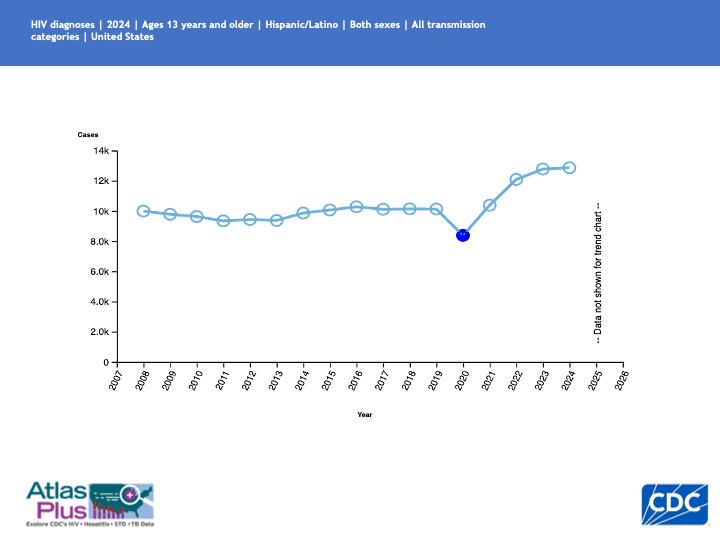
(Source: AtlasPlus, 2025)
Hispanic/Latine Americans account for 17.9% of all PrEP users—moderately higher than Black Americans (14.5%)—with a PrEP-to-Need ratio of 7.9, meaning that nearly 8 Hispanic/Latine Americans are using PrEP for every 1 new HIV diagnosis. By comparison, White Americans account for 62.9% of all PrEP users, with a PrEP-to-Need ratio of 41.7, meaning that nearly 42 White Americans are using PrEP for every 1 new HIV diagnosis (AIDSVu, 2026).
In our qualitative roundtable, participants indicated that the following issues served as primary barrier categories to knowledge about and access to PrEP and HIV care and prevention services:
Language Barriers
Law Enforcement & Immigration-Related Barriers
Medical Mistrust Barriers
Structural and Geographic Barriers
Social and Cultural Barriers
Stigma-Related Barriers
Financial Barriers
Of greatest concern were the impacts of immigration policies and law enforcement on access not just to PrEP and HIV services, but to healthcare services in general and to other functions of daily life, including going to work, attending school, or purchasing basic necessities such as groceries and household supplies. The truly palpable fear expressed (and experienced) by members of America’s Hispanic/Latine communities cannot be overstated. As one participant put it:
We have what’s called the Memphis Safe Task Force, made up of the National Guard, ICE, and other federal agents. Their presence has actually made our community less safe—people don’t feel comfortable to go out and buy groceries, go to their medical appointments, or pick up their prescriptions.
This is a reality that few other populations in America experience, and it’s one that PlusInc will make every effort to examine, highlight, and expose.
What’s Left
We are currently developing one-pagers and trifold brochures for distribution at public events. We are also working on targeted social media campaigns to help increase awareness of PrEP in the respective demographic groups.
Please stay tuned for further updates as the year progresses.