

PrEP is for Everyone: What We’ve Learned, So Far…
In January 2026, PlusInc announced the commencement of its “PrEP is for Everyone” campaign (Hopkins, 2026). This campaign, sponsored by Gilead Sciences—maker of Truvada, Descovy, and Apretude—was designed to increase awareness and eventually uptake of a PrEP regimen to prevent the acquisition of HIV.
In January 2026, PlusInc announced the commencement of its “PrEP is for Everyone” campaign (Hopkins, 2026). This campaign, sponsored by Gilead Sciences—maker of Truvada, Descovy, and Yeztugo—was designed to increase awareness and eventually uptake of a PrEP regimen to prevent the acquisition of HIV.
In the months after our announcement, we hosted 3 community roundtables with community members and subject-matter experts representing our three primary demographic groups: Black and Hispanic/Latine Americans and Women, during which we conducted qualitative research to identify barriers and facilitators to knowledge and access about PrEP, as well as to identify community-driven recommendations and potential solutions to overcome those barriers. In addition to this qualitative research, we conducted a literature review for the first two demographic groups, with additional literature being gathered for the third in the coming months.
While the majority of our findings are being reserved for the final report, which will be issued in the 4th Quarter of 2026, we’re pleased to share what we’ve learned, thus far…and what we’ve learned has been startling:
Black Americans
Black Americans compose just 14.7% of the United States population (U.S. Census Bureau, n.d.), but account for nearly 38% of all new HIV diagnoses, with a diagnosis rate of 41.9 new diagnoses (per 100,000 Black Americans).
These data aren’t new: Black Americans have long had the highest rates of new HIV cases out of any racial demographic group. When broken down into new diagnoses by sex (as opposed to gender, due to the availability of official data), Black Males account for 28.4% of all new diagnoses, while Black Females account for 9.3% (Centers for Disease Control and Prevention, 2025).
Despite the availability of highly effective medication-based HIV prevention methods, Black Americans account for just 14.5% of all PrEP users, with a PrEP-to-Need ratio of 5.8, meaning that nearly 6 Black Americans are using PrEP for every 1 new HIV diagnosis. By comparison, White Americans account for 62.9% of all PrEP users, with a PrEP-to-Need ratio of 41.7, meaning that nearly 42 White Americans are using PrEP for every 1 new HIV diagnosis (AIDSVu, 2026).
In our qualitative interviews, participants across two separate roundtables indicated that the following issues served as primary barrier categories to knowledge about and access to PrEP and HIV care and prevention services:
Medical Mistrust Barriers
Structural and Geographic Barriers
Social and Cultural Barriers
Stigma-Related Barriers
Financial Barriers
Information/Education Barriers
The details of these findings, as well as the community-driven recommendations to overcome them, will be shared in the full report.
Hispanic/Latine Americans:
Hispanic/Latine Americans compose 20.1% of the United States population, but account for nearly 34.2% of all new HIV diagnoses, with a diagnosis rate of 25.2 new diagnoses (per 100,000 Hispanic/Latine Americans).
Similar to diagnoses among Black Americans, Hispanic/Latine Americans have long represented nearly a third of new HIV diagnoses since at least 2008. The annual number of new diagnoses hovered around 10,000 new cases per year between 2008 and 2021, but rose to over 12,000 in 2022, where it remained in the following two years.
This increase in new diagnoses may be attributable to increased access to newly initiated or better funded HIV testing efforts in priority jurisdictions where Hispanic/Latine Americans represent larger percentages of the population, including those in Arizona (31.4%), California (48.4%), Florida (27.4%), Illinois (18.8%), Nevada (29.6%), New Jersey (22.5%), New York (19.8%), Texas (39.7%), and Puerto Rico (99%) as a result of funding from the Ending the HIV Epidemic (EHE) program (U.S. Census Bureau, n.d.; HIV [dot] gov, 2026)
Figure 1 - HIV Diagnoses Among Hispanic/Latine Americans Aged 13 and Older, 2024
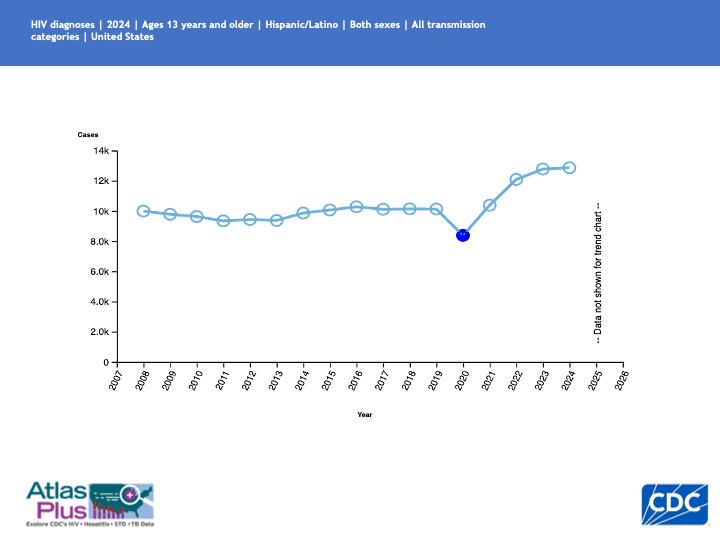
(Source: AtlasPlus, 2025)
Hispanic/Latine Americans account for 17.9% of all PrEP users—moderately higher than Black Americans (14.5%)—with a PrEP-to-Need ratio of 7.9, meaning that nearly 8 Hispanic/Latine Americans are using PrEP for every 1 new HIV diagnosis. By comparison, White Americans account for 62.9% of all PrEP users, with a PrEP-to-Need ratio of 41.7, meaning that nearly 42 White Americans are using PrEP for every 1 new HIV diagnosis (AIDSVu, 2026).
In our qualitative roundtable, participants indicated that the following issues served as primary barrier categories to knowledge about and access to PrEP and HIV care and prevention services:
Language Barriers
Law Enforcement & Immigration-Related Barriers
Medical Mistrust Barriers
Structural and Geographic Barriers
Social and Cultural Barriers
Stigma-Related Barriers
Financial Barriers
Of greatest concern were the impacts of immigration policies and law enforcement on access not just to PrEP and HIV services, but to healthcare services in general and to other functions of daily life, including going to work, attending school, or purchasing basic necessities such as groceries and household supplies. The truly palpable fear expressed (and experienced) by members of America’s Hispanic/Latine communities cannot be overstated. As one participant put it:
We have what’s called the Memphis Safe Task Force, made up of the National Guard, ICE, and other federal agents. Their presence has actually made our community less safe—people don’t feel comfortable to go out and buy groceries, go to their medical appointments, or pick up their prescriptions.
This is a reality that few other populations in America experience, and it’s one that PlusInc will make every effort to examine, highlight, and expose.
What’s Left
We are currently developing one-pagers and trifold brochures for distribution at public events. We are also working on targeted social media campaigns to help increase awareness of PrEP in the respective demographic groups.
Please stay tuned for further updates as the year progresses.
PrEP is for Everyone
PrEP is for Everyone
Introduced in 2012, PrEP has come a long way, from a daily oral single-pill regimen of Truvada (Gilead Sciences) that required patients to adhere to a relatively strict dose schedule to the first long-acting injectable prevention medication, Apretude (ViiV). Both the oral and injection-based regimens provide prevention rates of up to 99% when taken consistently and correctly. Like with most things, disparities exist, especially among Black and Hispanic Americans and Women
While these medications provide significantly more efficacy in prevention against HIV than condoms, uptake in the early years of availability was largely confined to affluent (and often White) gay men living in urban areas (Hammack et al., 2018). These low uptake numbers indicated the need for better, more targeted advertising and educational campaigns. That need continues today.
iStock Photo License Purchased by PlusInc
Despite the significant progress made over the past 20 years in reducing the number of new HIV infections in the United States, many patient populations still face significant disparities related to the disease, including the ability to access affordable HIV prevention, testing, and treatment.
In 2022, the most recent year for available HIV diagnosis and prevalence data, nearly 38,000 people living in the United States were diagnosed with HIV at a rate of 13.3 (per 100,000), with the highest diagnosis rates occurring in Black Americans (r = 41.0), patients aged 25-34 (r = 30.9), Hispanic/Latine Americans (r = 23.8), and Multiracial Americans (r = 23.5; Centers for Disease Control and Prevention, 2024).
HIV has a long history of being considered an “urban” disease, in no small part because of the epidemic’s beginnings in America’s largest metropolitan areas in the 1980s. Over time, epidemiology and better HIV education campaigns have helped both policymakers and the general population understand that HIV exists everywhere.
Despite this progress, testing, surveillance, and reporting for HIV outside of larger population centers continue to languish. While county-level diagnosis rates exist, they are largely inadequate when examining HIV diagnosis rates for the simple reason that most people living in rural counties must travel to receive HIV testing and diagnostic services. Furthermore, despite improvements in HIV case data collection and reporting, many organizations and providers who provide HIV testing services fail to link HIV diagnoses to patients’ counties of residence. This may contribute to rural counties reporting lower, suppressed, or no HIV diagnoses when there are, in fact, people now living with HIV in those counties. When examining the 2291 counties and independent Virginia cities designated as “rural” by the Federal Office of Rural Health Policy, the HIV incidence rate in 2022 was 5.3 for those counties. This is likely due to suppressed rates and inaccurately attributed diagnoses.
These disparities in HIV diagnosis have remained largely consistent over the past decade. Yet, both national PrEP utilization numbers (n = 591,475) and rates (r = 206.0) for 2024 indicate that the vast majority of PrEP users are overwhelmingly male (90.2%; r = 381.0) and White (62.9%; r = 218.0).
This is not to say, however, that PrEP utilization rates for Black and Hispanic/Latine Americans have not improved; to the contrary, the most recent data indicate that utilization percentages for both Black and Hispanic patients are roughly on par with national population percentages (Black PrEP Users n = 14.5%; Hispanic PrEP Users n = 17.8%).
We can, however, do better.
More accurately, we can reach more people who need PrEP to prevent the acquisition of HIV by reaching beyond major population centers. The development and release of long-acting injectable PrEP may allow patients who are HR/HT the opportunity to take advantage of more accessible options to prevent the acquisition of HIV.
For much of PrEP’s history on the market, patients have been turned away as being poor candidates because of reasons that may be beyond their control, including the distance to providers, geographic barriers, housing insecurity, homelessness, mental health issues, and substance use disorders. With the availability newer delivery modalities, including twice-yearly injections, we have the opportunity to increase PrEP uptake in patients who face increased risk of acquiring HIV, but have been unable to make the available options work for them.
PlusInc knows that patient populations are not monoliths; that patient experiences can vary widely, even within specific demographic groups. This requires organizations to work in collaboration and coordination to reach those most at risk of acquiring HIV to provide them with scientifically accurate and easy-to-understand informational and educational campaigns that meet patients where they are likely to see and absorb them. PlusInc will launch a national public awareness campaign in the coming weeks to address these health disparities, called “PrEP is for Everyone.”