

When Science Illiteracy Comes with Deadly Consequences
In June of 2025, Robert F. Kennedy, Jr., Secretary of the Department of Health and Human Services (HHS), fired all 17 members of the Advisory Committee on Immunization Practices (ACIP)—a vital panel of experts that advised the Centers for Disease Control and Prevention (CDC) that reviewed vaccine information and data and then made recommendations on who should be eligible to receive certain vaccines and whether insurers should cover them (Constantino, 2025). This was just the opening salvo fired by politically inspired voices within the Trump Administration, determined to dismantle nearly 100 years of progress in the global fight against preventable, crippling, and often fatal diseases.

Since that time, the Trump Administration has worked tirelessly to slander, punish, and remove highly regarded physicians and scientists (Yousif, 2025), and has instead elevated a seemingly endless parade of scientifically illiterate “vaccine skeptics” to positions of power, all while making scientifically false claims about the nonexistent link between vaccines and autism spectrum disorder (Stein & Huang, 2025), purposely stoking fears about the imaginary dangers of the childhood vaccine schedule (Horton & Drenon, 2026), and openly lying about how vaccines are tested (Manto, 2026).
Rather than go through a point-by-point refutation of every false or misleading claim made by the Trump Administration about vaccine science and vaccines themselves, PlusInc will instead highlight the real-world consequences of “vaccine skepticism” by giving a brief history lesson.
Did you know that the 1900 and 1910 U.S. Census asked families for the number of children born and the number still living?
It’s true!
In 1900, the Census began asking adult women to report the number of children they had ever given birth to and how many were still living (Haines & Preston, 1996).
You see, childhood mortality was so common prior to the widespread utilization of vaccines that it was not uncommon for families to give birth to multiple children, but have only a few survive to adulthood. A prime example of this is the Sherman Clark household, from Royalton, OH.
Mary C. Clark, wife of Sherman Clark, reported in the 1900 Census that she had given birth to 5 children, of whom 3 survived; in the 1910 Census, she reported that she had given birth to 8 children, of whom 5 survived. This indicates that she gave birth to three additional children between 1900 and 1910, but only one survived (Crow, n.d.).
Although the U.S. Census Bureau collected this information, it never reported the 1900 findings. The 1910 Census findings were released with the 1940 federal Census, but the Census Bureau never tabulated or released the child-survival information (Haines & Preston, 1996).
There are thousands of anecdotal stories of families with a dozen or more children born, but only a handful surviving, and many of those children died of preventable diseases, including pneumonia, diphtheria, dysentery, measles, various types of influenza, and other vaccine-preventable diseases (North, 2025). So high were the child mortality rates in the early-1900s that more than 18% of children never made it to the age of 5 (Haines & Preston, 1991).
Research published in the Journal of the American Medical Association (JAMA) in 2007 found that, after the production, distribution, and deployment of various vaccines, many diseases that were previously fatal were all but eradicated in America by 2006 (Table 1):
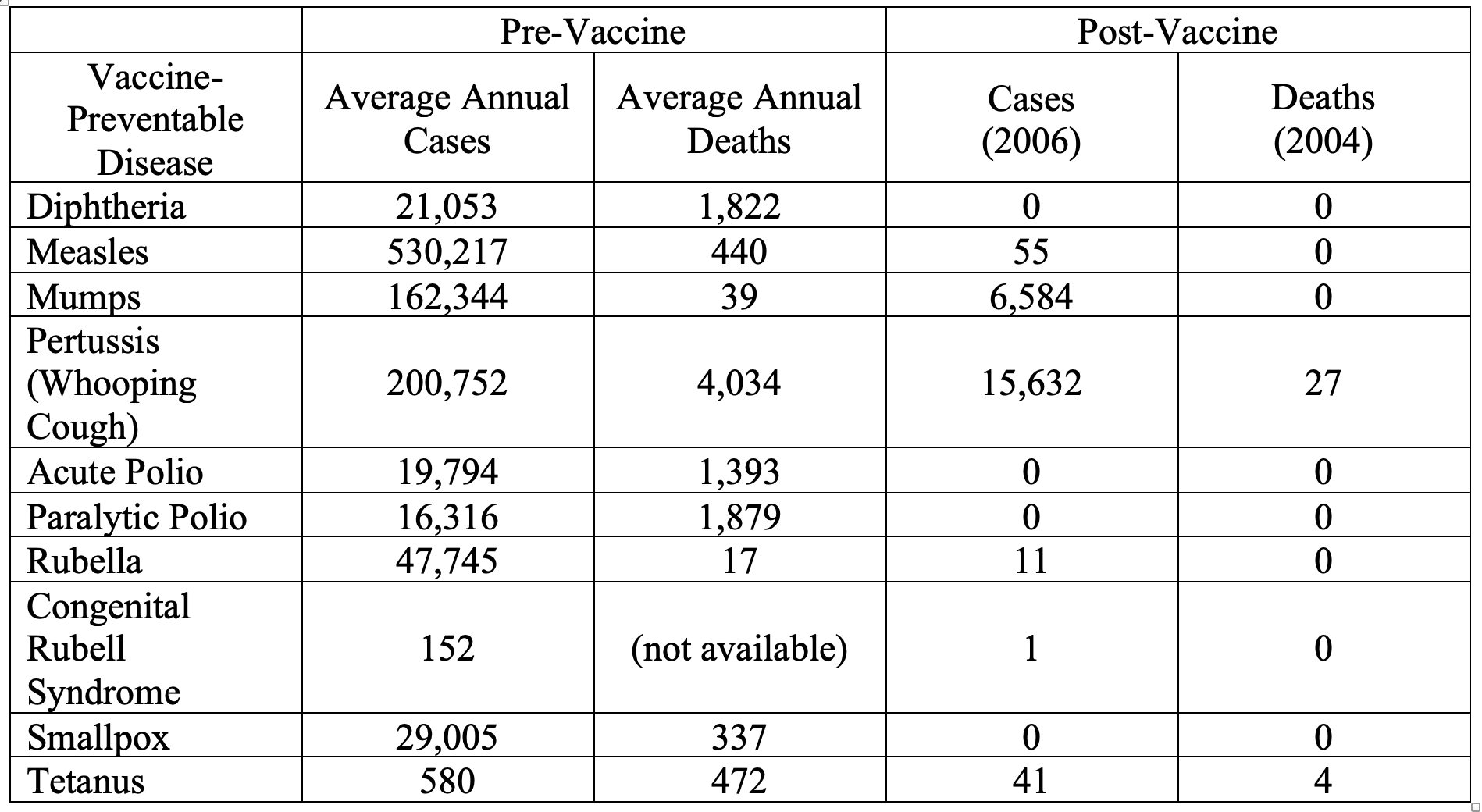
Source: Roush & Murphy, 2007
These aren’t imaginary numbers.
Implementing vaccine science in the American population led to more than 99% declines in cases of diphtheria, measles, paralytic polio, rubella, congenital rubella syndrome, and smallpox by 2006.
Beyond just preventing the deaths of children, vaccines also prevent the chronic, lifelong impacts that accompany these diseases. For example, mumps can lead to sterility (the inability to have children), encephalitis (brain swelling), pancreatitis (pancreas swelling), meningitis (swelling of the brain and spinal cord coverings), and hearing loss. Measles can permanently damage the immune system, making people more susceptible to pneumonia, encephalitis, and blood clotting disorders (Let’s Get Real, 2024).
This was widely accepted science in the U.S. government for over 100 years.
And then came the “vaccine skeptics.”
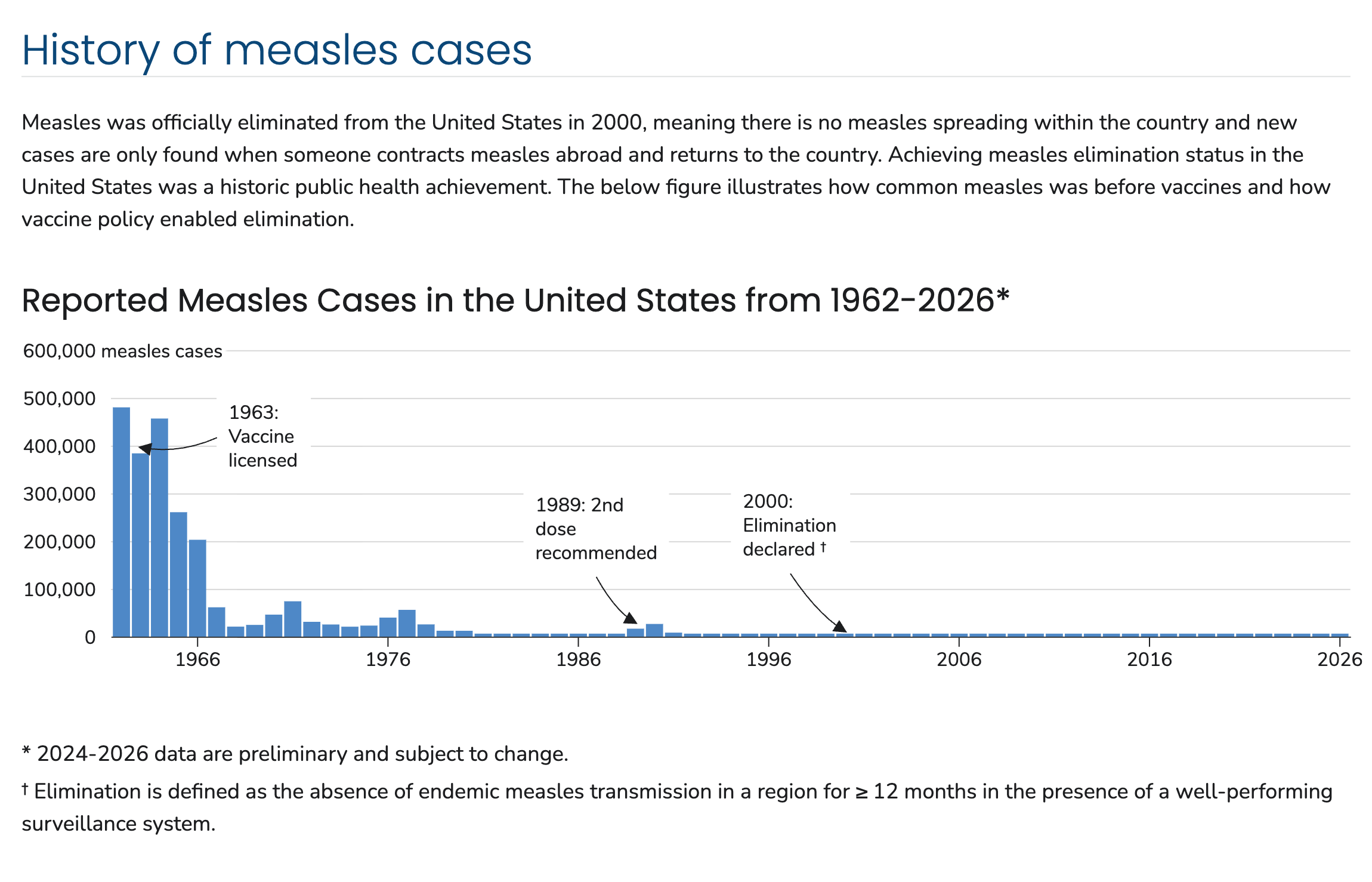
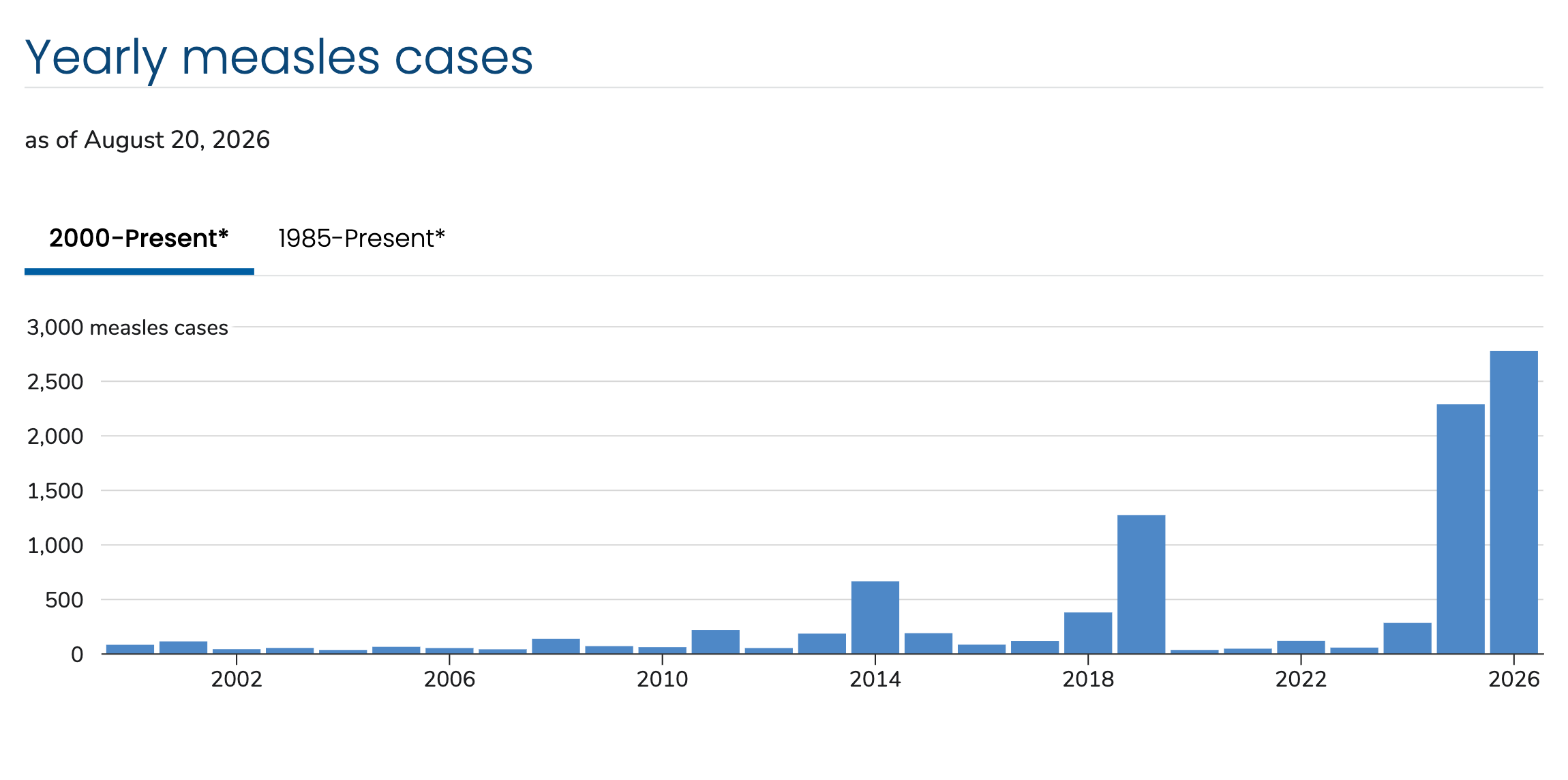
In 2025, there were 2,289 confirmed cases of measles in the United States, including 48 outbreaks (defined as 3 or more related cases), of which 90% of confirmed cases were part of an outbreak. In 2026, as of August 20th, there have been 2,777 confirmed measles cases, including 36 new outbreaks, with 94% of confirmed cases part of an outbreak (CDC, 2026). By comparison, there were just 285 measles cases, including 16 outbreaks, of which 69% of confirmed cases were part of an outbreak (Figures 1 and 2).
Figure 1 - Reported Measles Cases in the United States from 1962-2026:
Source: CDC, 2026
Figure 2 – Yearly Measles Cases, 2000-Present:
Source: CDC, 2026
Plainly put, it didn’t have to be this stupid. But it’s going to get stupider and deadlier.
According to data released by the CDC, the vaccination exemption rates for the Measles, Mumps, and Rubella (MMR) vaccine in U.S. kindergartens have steadily increased since 2013, from 1.6% to 4.2% in 2025, with a 17% increase in exemptions between 2024 and 2025, from 3.6% to 4.2%—the largest year-over-year increase ever recorded (Glenza, 2026). That’s nearly 280,000 children who are at risk of contracting these preventable diseases, passing them along to others, suffering the symptoms, and potentially dying.
Again…it didn’t have to be this stupid.
But, that’s where we are.
And we’re going to pay the price.